
Live resin wins on flavor and full-spectrum complexity, made from fresh-frozen flower that locks in terpenes before anything gets stripped away. Distillate wins on price, discretion, and predictable dosing, refined down to a nearly terpene-free THC base. If you’re chasing taste and a strain-true high, go live resin. If you want value and consistency, distillate is your play. Either way, don’t just chase the biggest THC number.
TL;DR:
- Live resin retains a higher percentage of terpenes, often between 5 and 15 percent, which enhances flavor and strain authenticity.
- Distillate usually tests at higher THC levels, but its lack of terpenes results in a less complex, more neutral flavor profile.
- Live resin typically costs 40 to 60 percent more per gram than distillate due to its cold-chain extraction process.
- The effects of live resin tend to last longer and feel more layered because of its fuller terpene and minor cannabinoid content.
- Proper hardware voltage settings are crucial for flavor preservation in live resin, with lower settings around 2.2 to 2.8 volts recommended.
Table of Contents
- Live Resin vs Distillate: How Extraction Shapes Everything
- THC and Terpene Ranges: What the Lab Report Actually Tells You
- Spotting the Difference by Look, Smell, and Feel
- Effects and Duration: What to Expect Once You Take a Pull
- Which Concentrate Actually Fits Your Routine
- The Real Cost Math Behind Distillate vs Live Resin Carts
- Getting the Most Out of Either Cart
- What Frydcarts Brings to the Live Resin Side of This Debate
- Health and Safety Considerations Unique to Each Type
- Beyond the Cart: Dabbing, Edibles, and Other Ways to Use Either Concentrate
- A Straight Answer From Someone Who’s Looked at Both Sides
- Try Frydcarts Live Resin Carts Without Guessing on Quality
- Where This Information Comes From
- Sources
- FAQ
Live Resin vs Distillate: How Extraction Shapes Everything
The difference starts at harvest, not in the lab. Live resin begins with fresh cannabis that gets flash-frozen within hours of being cut, then processed with cold hydrocarbon solvents like butane or propane while the plant material is still sub-zero. That cold chain is the whole point: it stops terpenes from evaporating before extraction, which is why live resin retains 3 to 15 percent terpenes by weight.
Distillate takes the opposite road. It starts with dried, cured flower, gets winterized to strip out fats and waxes, then runs through short-path distillation, essentially a high-heat, high-vacuum process that isolates pure THC molecules and discards nearly everything else, including native terpenes.
The trade-offs come down to:
- Cold-chain infrastructure: live resin needs freezers and fast turnaround, driving up production cost.
- Solvent choice: both use hydrocarbons, but distillate often runs a second solvent-recovery pass.
- Yield: distillate extracts more usable THC per pound of biomass; live resin sacrifices yield for flavor.
THC and Terpene Ranges: What the Lab Report Actually Tells You
Distillate typically tests at a high THC percentage reflecting its concentrated cannabinoid content. Live resin usually tests lower on paper because terpenes and minor cannabinoids occupy part of the formulation.
That gap confuses a lot of buyers who assume higher THC always means a stronger high. It doesn’t work that way. Terpenes and minor cannabinoids interact with THC to shape onset, intensity, and how long an effect lasts, a dynamic often called the entourage effect. A 65 percent THC live resin cart loaded with myrcene and limonene can feel heavier and more layered than a 90 percent distillate hit that peaks fast and fades clean.
The number that matters more than THC% might be terpene%. Quality live resin generally shows terpene content in the 5 to 15 percent range, and that figure predicts flavor fidelity far better than the THC line ever will.
Before you buy, check both:
- THC percentage for rough potency and dosing math.
- Terpene percentage for flavor strength and strain authenticity.
- Whether the lab report lists individual terpenes (myrcene, limonene, caryophyllene) or just a total.
Spotting the Difference by Look, Smell, and Feel
You can often tell these two apart before you even take a pull. Live resin announces itself the second the cap comes off: a loud, strain-specific aroma, a texture that ranges from sappy sauce to sugary crystals, and sometimes visible terpene separation pooling at the bottom of the tank. Distillate looks and smells almost clinical by comparison, a clear to light-gold oil with little to no scent on its own.
Here’s what to look for at the counter:
- Live resin: strong smell straight out of the packaging, strain-true flavor, thicker or sauce-like consistency, occasional crystallization.
- Distillate: pale, glass-clear oil, neutral or faint smell, uniform texture no matter the strain name on the label.
- Added terpenes: some distillate brands reintroduce terpenes after distillation, either cannabis-derived terpenes (CDT) or botanical ones sourced from fruit and plants.
That last point matters for anyone chasing authenticity. Botanical terpenes can taste convincing but don’t come from the actual cannabis plant, so read labels closely if strain fidelity is the whole reason you’re buying.
Effects and Duration: What to Expect Once You Take a Pull
Onset for both concentrates in a vape cart tends to hit within one to five minutes, but what happens after that diverges. Live resin’s fuller terpene load can stretch the plateau, the period where effects hold steady, longer than a comparable dose of distillate, which tends to peak faster and taper off in a more linear curve.
Dosing practice should look similar either way:
- Start with one small pull and wait 10 to 15 minutes before taking another.
- Space doses out rather than chain-pulling, especially with live resin’s more variable potency across strains.
- Track how many pulls it takes to reach your target effect so you can repeat it next session.
Some longtime users report that tolerance builds differently between the two, with distillate’s cleaner THC hit sometimes requiring more frequent upward adjustment than a terpene-rich live resin product. That’s anecdotal, not clinical, but it lines up with how cannabinoid-terpene interactions influence subjective response.
Pro Tip: If you’re switching from distillate to live resin, drop your usual pull count by half for the first session. The fuller effect profile sneaks up on people who are used to distillate’s faster, flatter curve.
Which Concentrate Actually Fits Your Routine
Matching the product to your actual habits matters more than matching it to whichever one tested higher on THC. Run through this:
- Evening tasting sessions or slowing down after work — pick live resin for the flavor and fuller-bodied effect.
- Discreet daytime use where smell matters — pick distillate; it’s quieter on the nose and easier to use without turning heads.
- Heavy daily use where cost adds up fast — pick distillate for the lower price per dose.
- Gifting or treating yourself to something special — pick live resin; it reads as the premium option because it is one.
- Running older or basic hardware — check your battery’s voltage range first, since live resin performs best on lower-voltage pens that protect its terpene content, while distillate tolerates a wider voltage range without much flavor loss.
The Real Cost Math Behind Distillate vs Live Resin Carts
Live resin generally costs 40 to 60 percent more per gram than distillate, a premium tied directly to the flash-freezing and cold-chain handling covered earlier. On shelves, expect roughly:
- Distillate carts: often priced lower per 0.5g to 1g unit, reflecting cheaper production.
- Live resin carts: priced higher per unit, with the gap widening for rare or dessert-flavored strains.
Do the math on a rough example: a 90 percent THC distillate cart and a 65 percent THC live resin cart at the same gram weight aren’t nearly as far apart in cost-per-mg as the sticker price suggests, especially once you factor in that some buyers report needing fewer pulls to feel satisfied with live resin. Distillate usually wins on straight cost-per-mg, while live resin can offer more perceived value per session if flavor and duration matter to you.
Getting the Most Out of Either Cart
Hardware choice changes the experience more than most buyers expect. Live resin’s volatile terpenes break down at high heat, so lower-voltage settings, typically in the 2.2 to 2.8 volt range depending on the device, protect flavor and prevent that burnt, harsh hit. Distillate’s simpler chemical makeup handles a wider voltage range without much flavor to lose in the first place.
- Store both cart types upright, away from direct sunlight and heat.
- If a cart gets cold and thick, warm it gently in your palm rather than with direct heat, which can degrade terpenes in live resin specifically.
- Count your pulls per session so you know when you’ve reached your usual dose.
Pro Tip: A clogged live resin cart is almost always a temperature problem, not a defect. Warm it in your hands for 60 seconds before your next pull.
What Frydcarts Brings to the Live Resin Side of This Debate
Frydcarts built its entire lineup around the flash-freezing method described earlier, extracting straight from fresh-frozen flower to lock in terpenes and cannabinoids before anything degrades. That approach is exactly why the brand leans into flavor-forward strains across Indica, Sativa, and Hybrid options, rather than settling for the neutral profile distillate delivers.
Every cart is built to hold onto strain character, which lines up with the terpene-preservation science covered above. If you’re evaluating any live resin cart, including Frydcarts’s own lineup, ask to see the lab-tested THC and terpene percentages before you buy. That’s the fastest way to confirm you’re getting real flavor fidelity, not just a strong number on a label.
Health and Safety Considerations Unique to Each Type
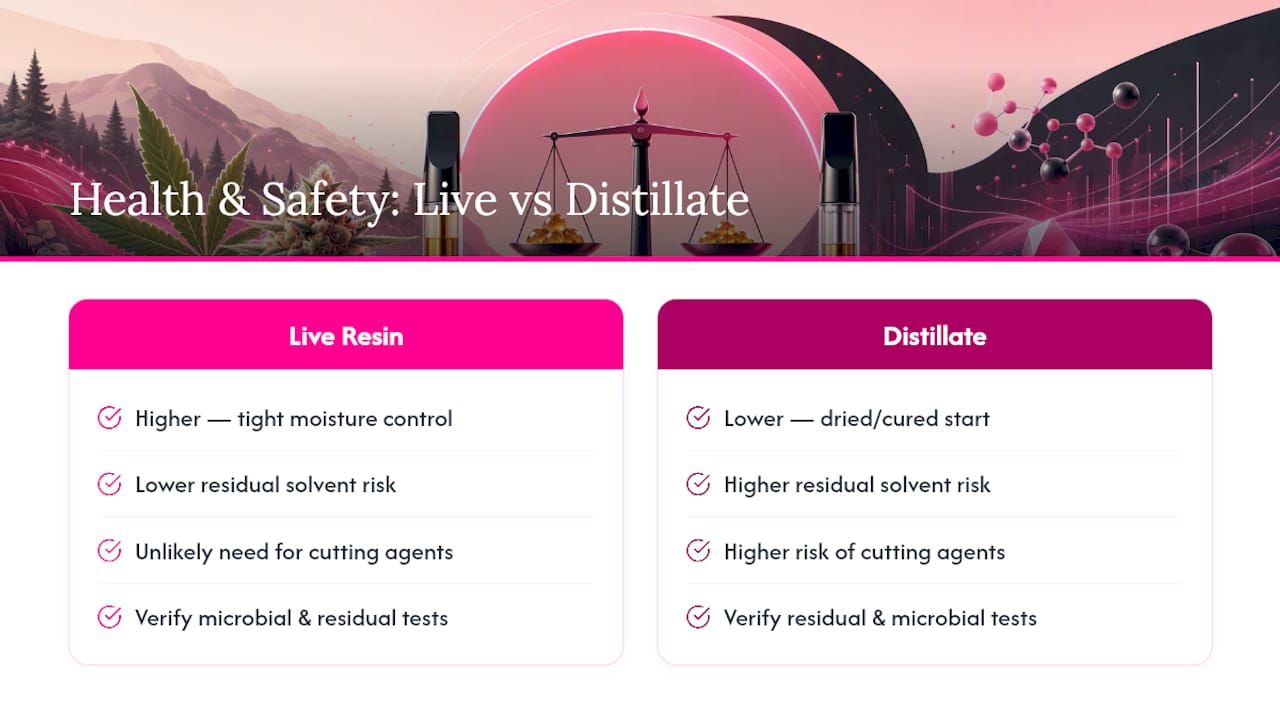
Both concentrates carry the general inhalation risks tied to any vape product, but a few differences are worth knowing. Distillate’s heavy refinement process, particularly short-path distillation, can leave trace residual solvents if a producer cuts corners on purging, which is why third-party lab testing for residual solvents matters more with distillate than with almost any other concentrate type.
Live resin’s fresh-frozen starting material carries a different concern: because the flower isn’t dried and cured first, moisture content needs tighter control during extraction to avoid mold or bacterial contamination making it into the final product. Reputable producers test for both microbials and residuals, but it’s worth checking a certificate of analysis rather than assuming.
Some distillate products also use cutting agents like vitamin E acetate in unregulated or gray-market carts, a practice tied to serious lung injury cases in past years. That risk drops sharply with products tested by licensed, regulated labs, but it’s a reason to avoid unbranded or unverified distillate carts regardless of price. Live resin doesn’t typically need cutting agents since its natural terpene content already thins the oil for cart compatibility, but that’s a production choice, not a guarantee, so lab verification still applies to both.
Whichever concentrate you choose, buying from licensed sources with published lab results is the single biggest safety lever you control.
Beyond the Cart: Dabbing, Edibles, and Other Ways to Use Either Concentrate
Vape carts aren’t the only format either concentrate comes in, and the differences show up just as clearly in other consumption methods. Dabbing is the classic way to experience both live resin and distillate in their rawest form, using a rig, nail, and torch to vaporize a small amount at high heat. Live resin dabs tend to showcase terpene flavor even more intensely than a cart does, since there’s no cartridge hardware limiting airflow or heat distribution. Distillate dabs, by contrast, tend to taste flat and one-note, which is part of why distillate is more commonly reformulated into other products than dabbed on its own.
Edibles are where distillate actually shines. Its neutral flavor and stable, pourable consistency make it the preferred base for gummies, chocolates, and other infused foods, since it doesn’t fight with added flavoring the way a terpene-heavy live resin extract can. That’s also why bulk food-safe THC products lean on distillate almost universally.
Live resin shows up less often in edibles but more often in specialty concentrates like badder, sauce, and sugar, sold for dabbing or mixing into flower. If you’re exploring formats beyond vaping, matching the concentrate to the format matters just as much as matching it to your desired experience.
A Straight Answer From Someone Who’s Looked at Both Sides
Pick live resin when the flavor and the ritual of the session matter to you. Pick distillate when you want predictable, cost-effective potency without much fuss. Neither one is objectively better, they’re built for different goals, so compare the actual lab numbers and taste for yourself before deciding which one earns a permanent spot in your rotation.
— fryd
Try Frydcarts Live Resin Carts Without Guessing on Quality
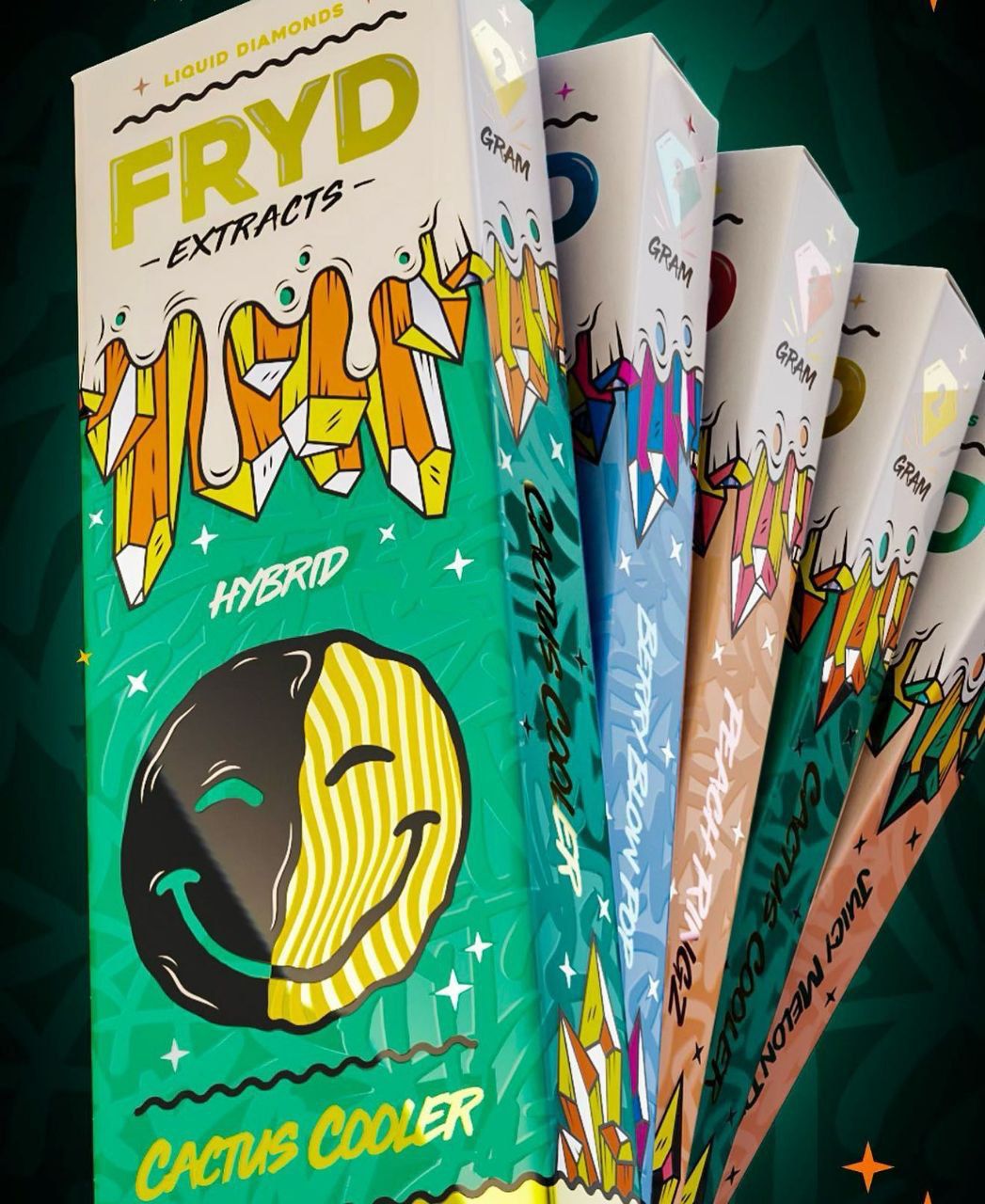
Frydcarts sells exactly the kind of flash-frozen, terpene-rich live resin carts this whole comparison points to, without the neutral, stripped-down profile that distillate leaves behind. If the flavor and strain fidelity sections above sold you on live resin, three carts are worth a look. Cactus Cooler Fryd Carts brings a tropical, citrus-forward terpene profile suited to daytime sessions. Berry Zkittles Fryd Carts leans into a candy-sweet berry flavor that showcases exactly the kind of strain character distillate can’t replicate. Strawberry Lemoncello Fryd Carts fits the dessert-flavor lane for anyone who wants a tart, dessert-style finish.
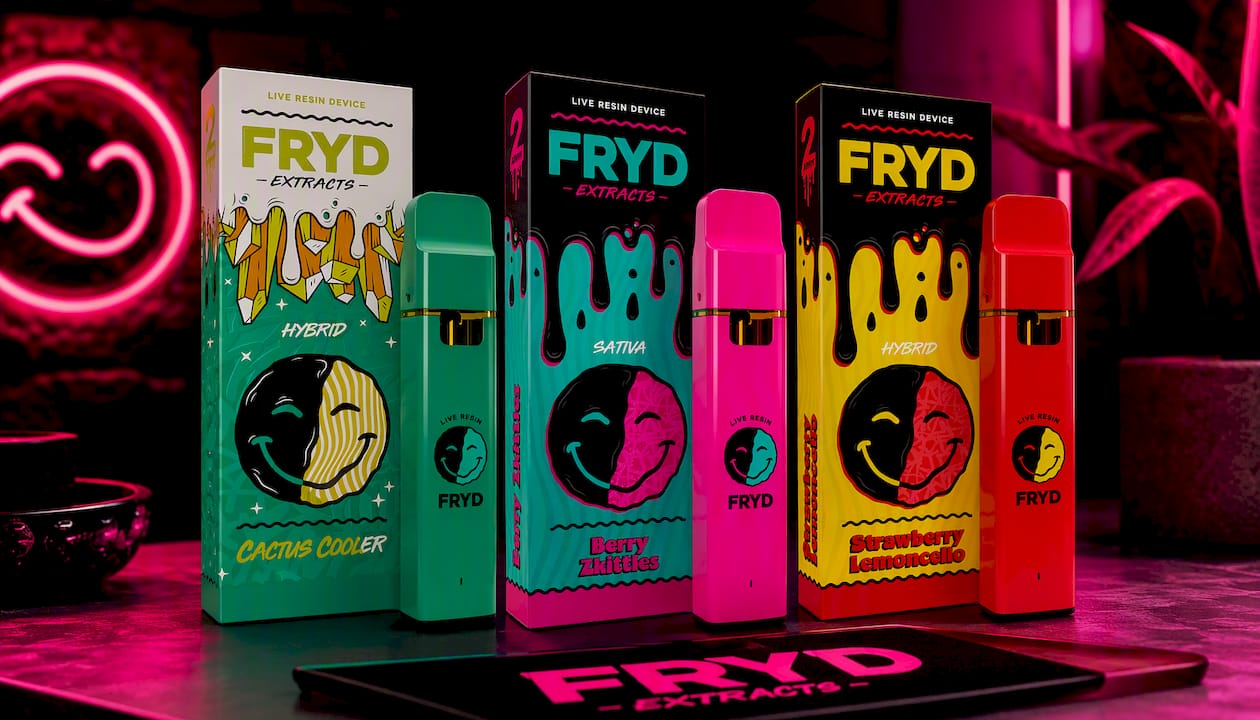
Every cart is available as a single purchase or through bulk options for anyone stocking up or reselling. Before you buy any live resin cart, from Frydcarts or elsewhere, pull up the lab report and check both THC and terpene percentages against what’s covered above. Ready to taste the difference for yourself? Add one of these three carts to your cart and place your order today.
Where This Information Comes From
- Leafly’s live resin glossary backs the extraction process and terpene-percentage ranges cited throughout.
- Herb’s cart comparison guide supports the experience-first decision framework.
- The PMC review on cannabinoids and terpenes grounds the entourage-effect and dosing discussion.
- Vaping360’s hardware comparison supports the battery voltage and cart-behavior guidance.
Sources
- Live resin | Leafly
- Live resin vs distillate: Which cart is right for you? | Herb
- PMC article on cannabinoids and terpenes
- Live resin carts vs distillate carts | Vaping360
FAQ
Is Live Resin Better Than Distillate?
Neither is universally better; they’re built for different goals. Live resin wins on flavor and strain fidelity, while distillate wins on cost and dosing predictability.
Is Live Resin Stronger Than Distillate?
Not necessarily in raw THC terms. Distillate typically tests at a high THC percentage compared to live resin’s usually lower paper THC numbers, but terpene content shapes perceived strength and duration beyond what the THC number shows.
Are Live Resin Carts Worth the Higher Price?
For flavor-focused users, yes. Live resin typically costs 40 to 60 percent more per gram than distillate, a premium tied to the fresh-frozen extraction process covered earlier in this guide.
How Much Do Frydcarts Live Resin Carts Cost?
Current pricing for individual carts like Cactus Cooler, Berry Zkittles, and Strawberry Lemoncello is listed directly on each product page, with bulk pricing available for larger orders.
What Voltage Should I Use for a Live Resin Cart?
Stick to the lower end of your device’s range, generally around 2.2 to 2.8 volts. Higher heat degrades the volatile terpenes that give live resin its flavor, while distillate tolerates a wider voltage range without much flavor loss.
